Application & Construction
Performance characteristics and construction techniques
Masonry mortars – a crucial element of masonry construction system
Loading...
Tomasz Rybarczyk holds degrees in Civil Engineering (Wrocław University of Science and Technology) and Architecture (University of Technology and Arts in Applied Sciences, Warsaw). He later completed postgraduate studies in management, building safety, and interdisciplinary BIM, and earned a PhD at the Silesian University of Technology with a dissertation on the load-bearing capacity of AAC walls.
Professionally, he has worked in design offices, on construction sites, and in manufacturing plants for building materials and precast concrete elements. He holds unlimited design licenses in the construction specialty and is a certified construction appraiser. He is an active member of the National Chamber of Polish Architects and the Polish Chamber of Civil Engineers.
He has authored numerous technical studies, articles, and expert opinions, presented at scientific conferences, and represents his field in the Technical Committees of the Polish Committee for Standardization.
Function of masonry mortars
Masonry is a composite building element made of masonry units joined together with mortar. Masonry mortars perform important functions within the masonry:
· joint masonry units – adequate adhesion between mortar and masonry units is important. Mortar should ensure the required strength of the masonry depending on a load type: compressive, bending and shearing strength,
· uniformly transfer loads between masonry units – it is important to lay mortar uniformly on surfaces of joined elements.
· ensure tightness (lack of tightness results in, inter alia, water penetration and humidity migration, acoustic bridges, deterioration of fire safety, lack of fire integrity, etc.),
· ensure the adequate deformability of masonry – the presence of lime and other additives provides flexibility and reduces the risk of fractures and cracks (to some extent, naturally),
· act as a “filter” – it is particularly important for unplastered masonry walls, made of low water-absorption masonry units, which consequently have longer drying time – lime additive in the mortar facilitates drying of wet masonry, lime mortar provides a greater barrier against moisture,
· should provide the adequate thermal insulation of the masonry wall (no thermal bridges should be observed) – it refers to mortars applied in single-layer walls without heat insulation, which is often the case with AAC,
· should enable the performance of wall reinforcement (laid in the wall where strengthening is required),
· should enable connections between walls (e.g. if connections are made using specific steel fasteners, they should be placed within the joint thickness),
· should enable the adjustment of units used in the walls (it refers to lintels, which should be laid in the wall using masonry mortar).
The above shows that mortars should enable the correct performance of walls regarding many aspects. Thus, the proper selection of mortar is necessary.
Masonry mortars vs. masonry units
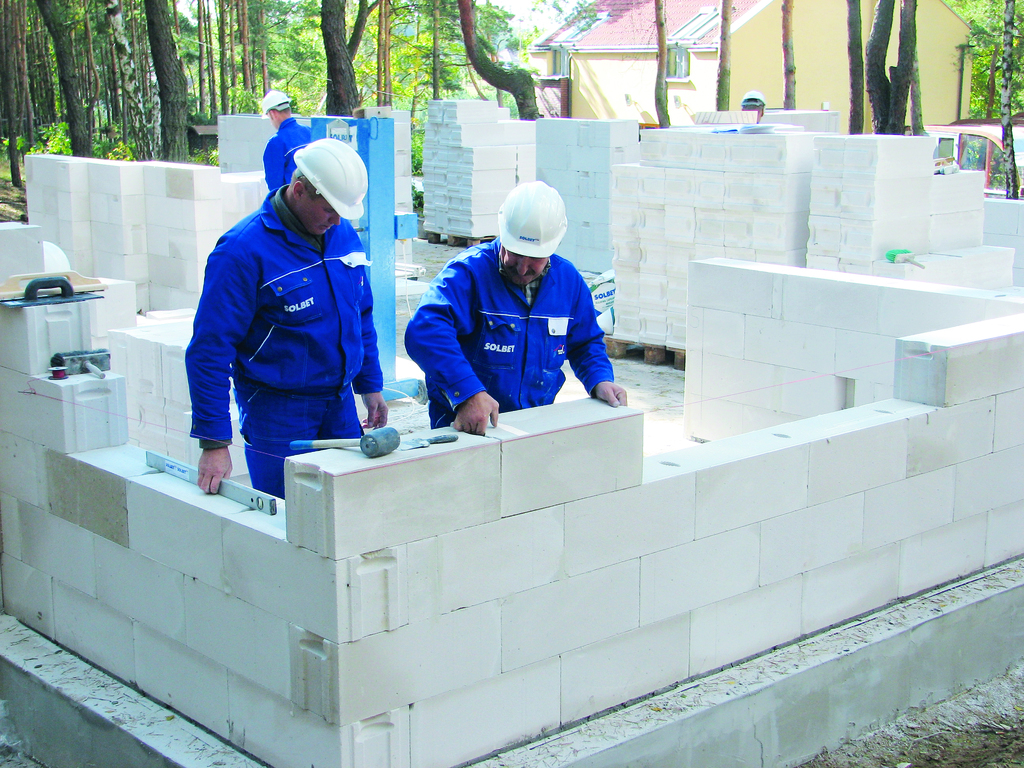
Currently, the most common masonry units are blocks or hollow bricks, which are quite large elements with precise dimensions. It means that they can be laid using thin-joint mortars, general-purpose masonry mortars, and polyurethane adhesives. Dimensional precision of masonry units does not define the bricklaying method, but gives the possibility to perform bricklaying. Thin-joint mortar can be used when masonry units are even and dimensional deviations allow the application of this type of mortar, which is the case with AAC blocks. But if a contractor does not want to use thin-joint mortar, the general-purpose masonry mortar can be applied as well. The technique of performing masonry walls with thin joint has been widely adopted and has been commonly used for many years. There are no statistics if general purpose masonry mortar has been replaced with thin-joint mortar, but in some regions thin-joint mortars at construction sited are much more common.
Mortar types
The most popular masonry mortar is mortar for thin joints (thin layer masonry mortar, commonly referred to as the adhesive (which is not correct) or adhesive mortar, and general-purpose masonry mortar (cement or cement-lime mortar). There are also lightweight mortars existing, that is, thermal insulating mortars. Adhesives have been also used for some time in wall construction. They cannot be considered as mortars because they are not specified in the harmonized standard [1].
Masonry mortars differ in, among other things, thickness of laid joint, the application technique, properties, intended use, and wear rate. Joint thickness in walls is specified in the masonry standard [2]. Thickness of bed and vertical joints with mortars for thin layers should be within a range from 0.5 - 3mm. When general-purpose or lightweight mortars are used, the real thickness should be within a range from 6 - 15mm. Walls erected with general-purpose mortars can have joints with thickness from 3 - 6mm if the applied mortars have been specifically developed for a particular application.
Not too high compressive strength is recommended for masonry mortars. It is crucial. Some contractors/investors, and even designers think that the higher strength of mortar, the better. But this is wrong. Compressive strength of mortar should be similar to that of masonry units!
Thin layer mortars
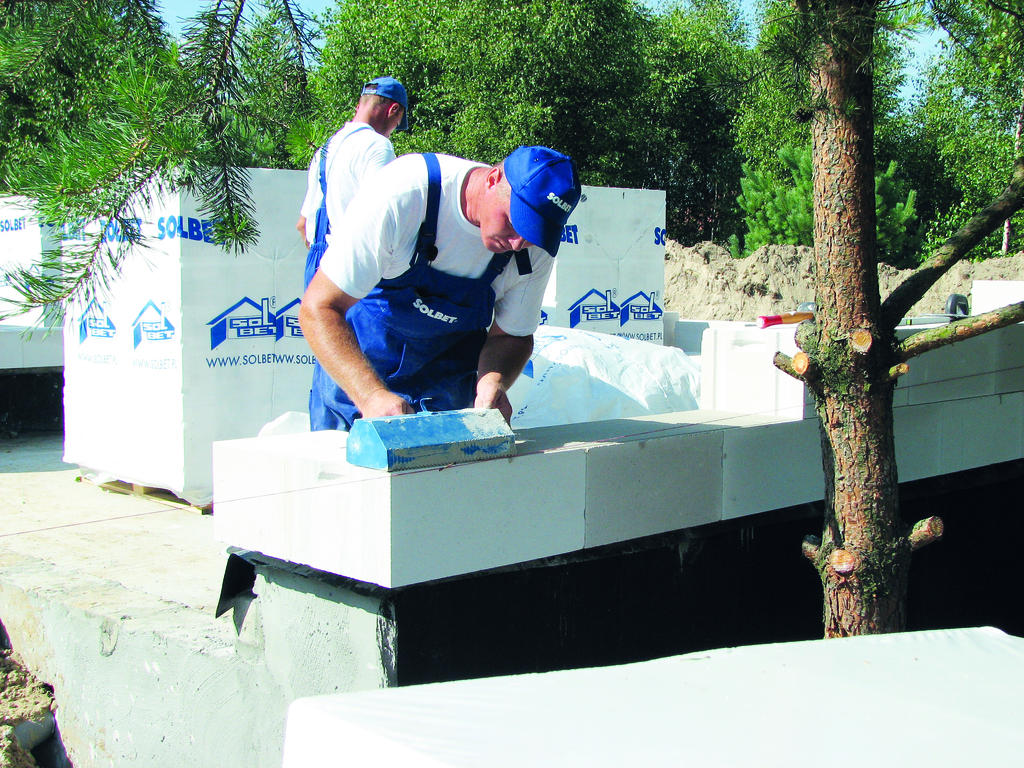
Mortars for thin layers are cement mortars. After bonding in the masonry, their thickness should be up to 3mm. For that reason, they contain the additive of small aggregate to obtain this thickness of joints. A special masonry trowel with an adequate shape and a correct height of teeth is required for providing the proper thickness of mortar. (Contractors often use tile trowels, which is wrong). Masonry mortars for thin layers joint masonry units in the wall. They should not be used to level irregularities in the wall. This type of mortar is used with masonry units characterized by high dimensional accuracy, which provides joint thickness up to 3mm. Hence, thin layer mortar can be used for blocks with tongue and groove or without in the walls with bed (horizontal) joints and filled or unfilled head (perpend) joints. Though it can appear otherwise, bricklaying with thin layer masonry mortar is much easier than with the general-purpose masonry mortar. This mortar does not require such proficiency as the general-purpose masonry mortar, where masonry units may flow in the thick layer of mortar. It is sufficient to obey construction recommendations, apply mortar with a trowel for thin joints, and inspect each layer in horizontal and vertical direction.
Thin joints mean less technological moisture in the masonry during bricklaying, and shorter drying time of the wall. The wall constructed with thin layer masonry mortar is considered to be thermally homogeneous as the impact of joints is negligible.
General purpose masonry mortars
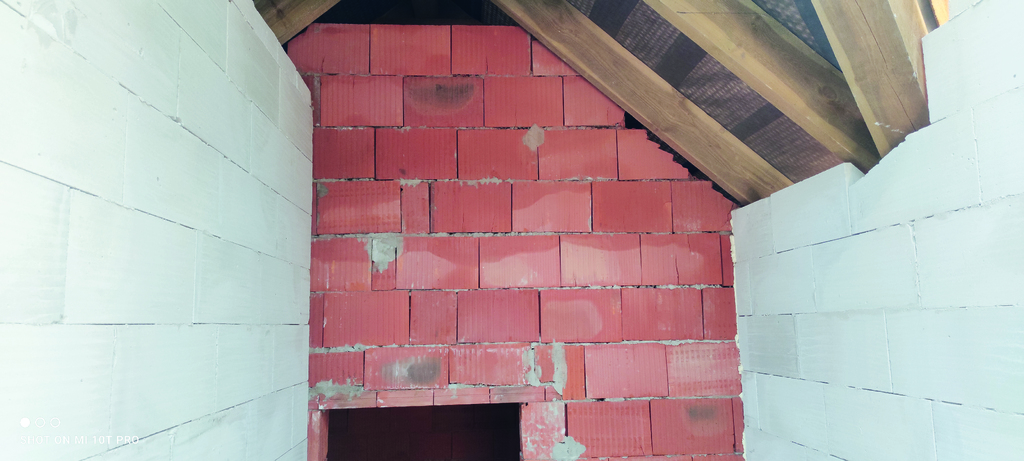
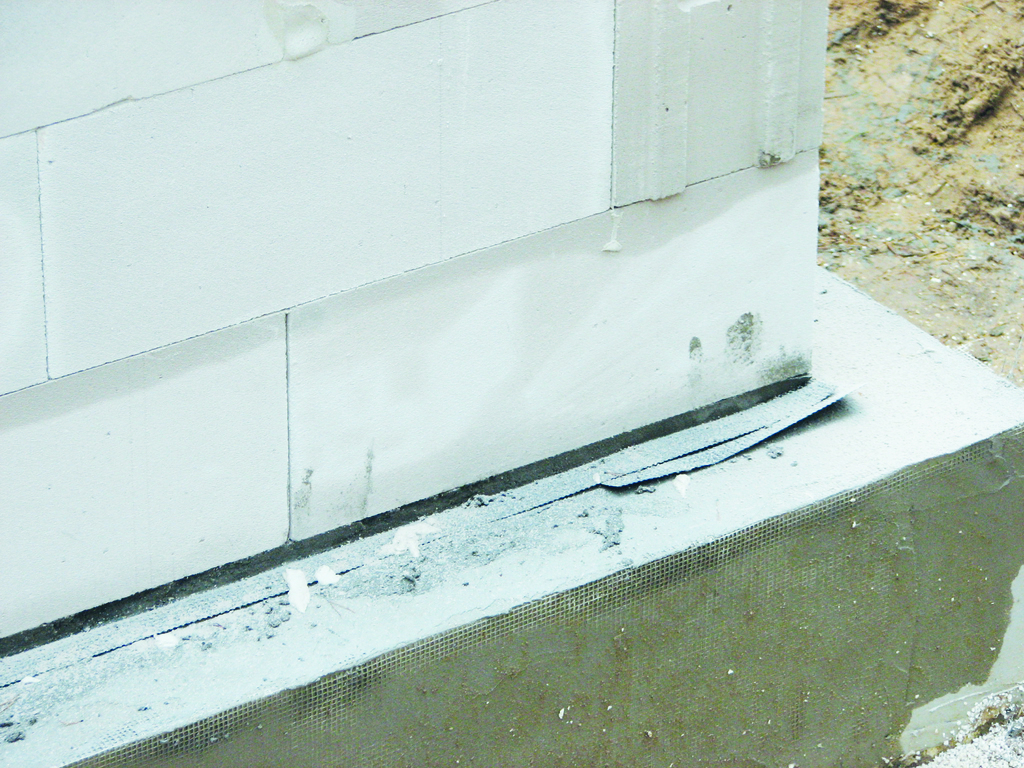
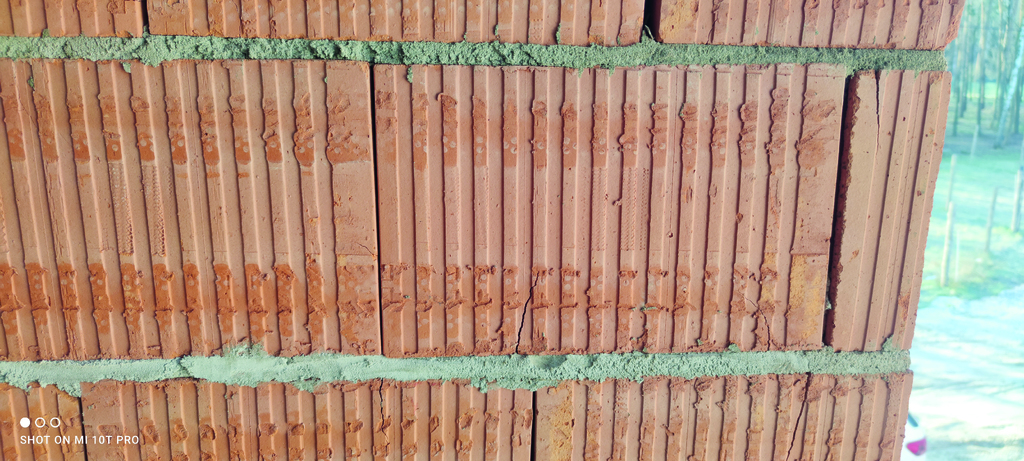
General-purpose masonry mortars also include thin layer mortars and cement mortars. Joint thickness in the wall should be within a range from 6 - 15mm. The application technique is conventional with a brick trowel. Each masonry unit – both with more or less precise dimensions, can be laid. This type of mortar joints masonry units and levels each layer. General-purpose masonry units are not used with masonry units for single-layer walls without heat insulation because the wall would not have homogeneous thermal insulation (a network of joints would form a network of thermal bridges). General-purpose masonry mortar can be used for blocks with tongue and groove or without in the walls with bed (horizontal) joints and filled or unfilled head (perpend) joints.
Lightweight masonry mortars
Lightweight mortars (also known as “insulating” or “thermal” mortars) have a low density, which is why they are classified as lightweight, and they provide better thermal insulation than standard cement mortars. Mixes of these mortars are enriched with perlite, or expanded polystyrene beads, or expanded clay balls, which ensures their satisfactory thermal insulation. Due to quite high fraction of an additive providing better thermal insulation, this mortar is applied in layers with a thickness of 6 - 15mm. However, their thermal insulation is worse than that of masonry units, which are today used in single-layer walls without heat insulation. Hence, they are less popular.
Polyurethane adhesives
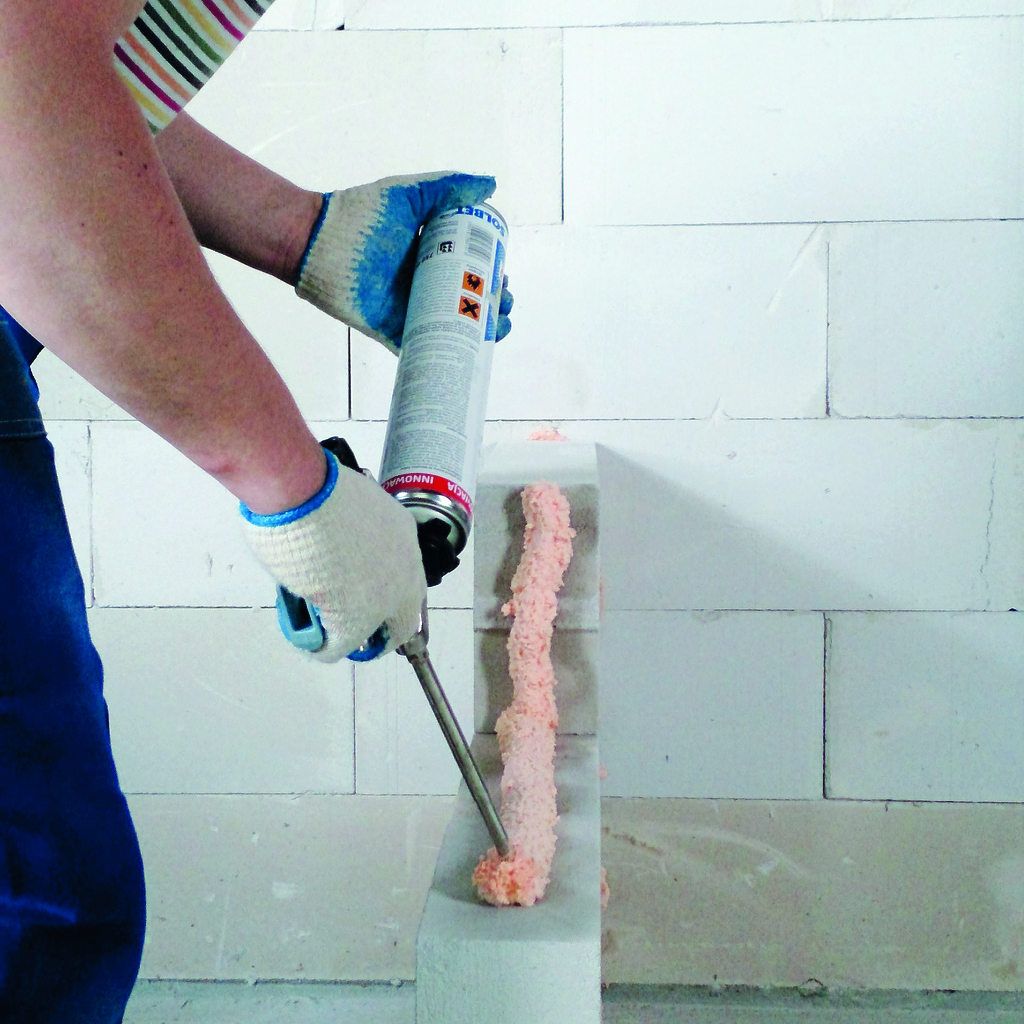
Polyurethane adhesives are another product used in masonry construction. These products are not mortars. They are used to perform masonry walls from very precise masonry units: autoclaved aerated concrete block units or polished ceramics. Adhesive is spraying applied in stripes directly from a dispensing device (the can). Joints in the completed masonry have a thickness in the order of tenths of millimetre – it is a layer of the adhesive film between masonry units. It is only used to glue masonry units. Adhesive cannot be used to level even the smallest irregularities. It is not recommended to fill gaps in head joints. Otherwise, acoustic bridges can be formed and areas with a high probability of breaking the adhesive structure in the foam layer can be identified. But adhesives cannot be used for the whole masonry. If masonry walls are made with polyurethane adhesive, no reinforcement can be used in the wall, where strengthening is required – it also refers to spandrel areas. Standard mortar is recommended for places of lintel supporting because dimensional precision of lintel beams is different than that of masonry units.
It should be mentioned that polyurethane adhesives are placed on the market and authorised for use on the basis of the National or European Technical Assessment. It means the reference documents contain the range of their application, design and construction guidelines. Therefore, it is recommended to get familiar with the reference documents and get to know important information, such as how to apply the product, for which masonry units, etc.
Important tips for performance
Considering mortar application, in addition to the proper technique of masonry construction, the use of tools for applying mortar, also the temperature of mortar application is very important.
All mortars should be applied within a temperature range from +5oC to +25oC – it refers to both the air temperature and the ground that is masonry units, temperature. The so called “winter” mortars, offered by some manufacturers, are intended for bricklaying in mild winter conditions at temperatures close to 0oC, but not lower.
As regards polyurethane adhesives, manufacturers recommend their application at temperatures within a range from -5oC to +35oC (the adhesive temperature should range from +10 oC to +25 oC, and optimally from +10 oC to +20 oC). Adhesive bonding requires relatively high moisture content. It is even recommended to spray masonry units with water.
Selection of mortar
As it has been already mentioned in the introduction, selection of suitable mortar for masonry units is very crucial. Masonry is a composite building element made of masonry units joined together with mortar. The mortar should be adapted to the properties of the masonry units. In the case of AAC, we're dealing with units with precise dimensions and low compressive strength. Therefore, for masonry with AAC blocks, it's best to use thin-joint mortars with low compressive strength. Mortar for AAC, it should have a compressive strength of up to 5 N/mm². This is an important aspect of wall design and construction, including AAC walls. Therefore, design guidelines and instructions of masonry unit manufacturers should be followed.

[1] EN 998-2 Specification for mortar for masonry - Part 2: Masonry mortar
[2] EN 1996-1-1 Eurocode 6: Design of masonry structures - Part 1-1: General rules for reinforced and unreinforced masonry structures