Science & Innovation
Setting benchmarks in AAC sorting and recycling
DIN SPEC 91493 turns demolition-site AAC into a recyclable resource
Loading...From July 2025 to March 2026, DIN SPEC 91493 [1] was created to set standards for the recycling and sorting of autoclaved aerated concrete. The DIN SPEC consortium brought together key players across the value chain:
· Verband Bauen in Weiß e. V., represented by Xella Technologie- und Forschungsgesellschaft mbH
· Bundesverband Porenbetonindustrie e.V.
· Otto Dörner Entsorgung GmbH
· Xella Deutschland GmbH
The German version of DIN SPEC 91493 was published by DIN Media in May 2026 [1]. The English version will follow in July 2026. Both documents are available free of charge.
The construction sector is undergoing a structural transformation driven by environmental policy, economic pressures, and the need to conserve primary resources. In particular, decreasing landfill capacities, rising disposal costs, and regulatory requirements for recyclability are accelerating the transition toward circular material systems.
AAC, a widely used building material with advantageous thermal and structural properties, plays a vital role in this context. While AAC production already includes efficient internal recycling loops, post-demolition AAC (AAC waste) has historically been underutilized. The primary reason is contamination with foreign materials during demolition and dismantling processes, which limits its suitability for high-quality reuse.
Establishing a circular economy for AAC requires overcoming these limitations. This involves defining clear quality criteria, reliable sorting procedures, and standardized testing methods. DIN SPEC 91493 provides such a framework. It enables stakeholders across the value chain – from demolition contractors to manufacturers – to process AAC waste into usable secondary raw material while maintaining product quality, environmental safety, and process stability.
Current state of AAC circularity
The production of AAC already involves material cycles: Uncured cutting residues are suspended in water and returned to the AAC production process. Cured broken material is crushed and screened; the coarse fraction is processed into granulate products by AAC manufacturers, whilst the fine fraction (AAC powder) is often reused in the production of new AAC - a practice that has proven its worth for decades. Manufacturers also take back sorted, separately collected AAC residues from construction sites and use them for the production of AAC granulates or powder.
In contrast, AAC waste represents a significantly different material stream. Material extracted from demolition sites is often mixed with various foreign substances. These impurities complicate the processing and reduce the feasibility of high-quality recycling. However, low-grade recycling pathways – such as road construction, earthworks, or landfill engineering – are only of limited suitability due to the low dimensional stability, limited frost resistance, and leachable sulfate content of AAC. As a result, AAC is currently mostly disposed of in landfills.
However, if AAC waste achieves a sufficiently high degree of purity, it can be returned to existing material cycles. Studies have shown that for the reuse in AAC production, a minimum AAC content of 95 wt% is required, with the proportion of mineral contaminants – i.e., plaster, mortar, gypsum, calcium silicate units, and concrete – remaining below 5 wt%, and other foreign materials not exceeding 1 wt%. In addition, hazardous substances and process-interfering materials must be completely removed (the technological approaches used to meet these purity requirements will be published in issue 4, 2026 of AAC Worldwide).
If this level of purity is achieved, the material can be processed into granulates or powder with properties equivalent to primary materials. AAC products manufactured with recycled AAC show no significant differences in mechanical, thermal and hygrothermal properties as well as durability.
If sufficient material purity cannot be achieved but recycling is still desired, it can be assessed whether the material is suitable for the production of technical granulates (e.g., absorbents, insulation fills) or for cement clinker production.
What a DIN SPEC is
A DIN SPEC (“Specification”) is a document published by DIN (Deutsches Institut für Normung e.V.) using the PAS (“Publicly Available Specification”) procedure. It enables the rapid development and publication of technical specifications for non-standardised technologies, supporting their fast market introduction. DIN SPECs are aligned with existing German standards and can serve as a starting point for later standardization processes.
DIN SPEC 91493 – Purpose and scope
DIN SPEC 91493 “Aufbereitung, Verwendung und Anforderungen an die Sortenreinheit für rezyklierten Porenbeton” (English: Preparation, utilization, and sorting accuracy requirements for recycled autoclaved aerated concrete) was developed as a practical and application-oriented guideline for AAC recycling. It addresses all stakeholders involved in the lifecycle of AAC, including demolition companies, recycling firms, building material manufacturers, planners, architects, and regulatory authorities.
The specification is structured around five core elements:
1. Description of AAC life cycle and recycling pathways
2. Classification of recycled AAC based on composition and purity
3. Definition of requirements for quality assessment and acceptance
4. Specification of sampling and sample preparation procedures
5. Analytical methods for monitoring environmental and technical parameters
Moreover, the document distinguishes three main application areas:
1. use as filler in the 0-1 mm grain size range for the production of AAC products in accordance with DIN EN 771-4 [2], DIN EN 12602 [3], DIN 4166 [4], as well as to all AAC products subject to technical approval that are manufactured using recycled AAC,
2. use as other products with high varietal purity (e.g., animal bedding, oil and chemical binders, vegetation substrates, filtration media, fertilisers, substrates for landfill construction, soil improvers), and
3. use as other products with low varietal purity (e.g., insulation fillings, manufacture of cement clinker).
This classification system enables recycled AAC to be categorized according to specific quality grades, thereby ensuring the optimal use of resources. The German edition of DIN SPEC 91493 was published in May 2026 [1], with the English edition to follow in July 2026; both are available free of charge.
Processing scenarios
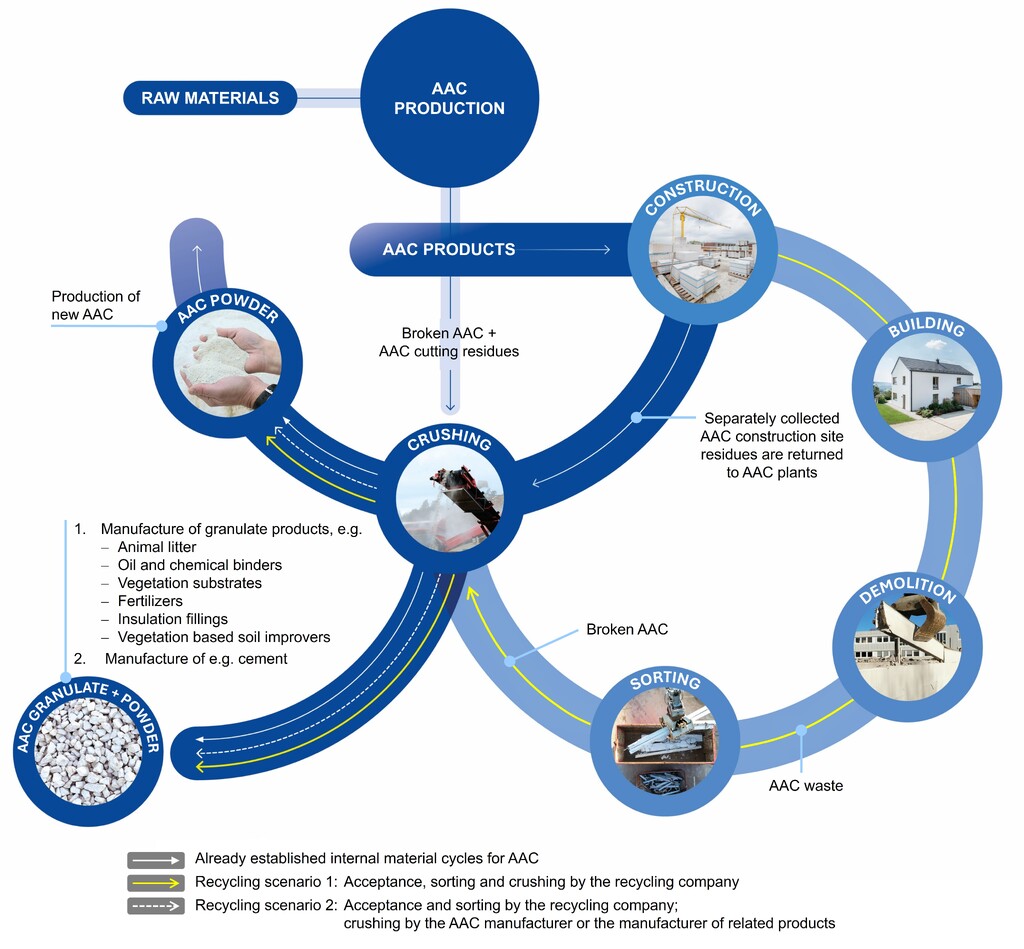
DIN SPEC 91493 defines two recycling scenarios for the handling of AAC waste (Fig. 1). In both scenarios, sorting by the recycling company is the key step for achieving the required level of purity. Already established processing pathways for AAC production residues and single variety AAC residues from construction sites are also indicated (white solid arrows), but do not fall within the scope of the DIN SPEC.
Recycling scenario 1
The recycling company performs both sorting and crushing. The resulting AAC granulate, or powder is delivered to the manufacturers for further use (yellow arrows in Fig. 1).
Recycling scenario 2
The recycling company only carries out the sorting. The sorted AAC is delivered to manufacturers, who then perform the crushing and further processing of the material (white dashed arrows in Fig. 1).
Purity requirements
To enable consistent classification and use of recycled AAC, DIN SPEC 91493 defines limit values for constituents and contaminants. Table 1 shows the requirements for maximum permissible proportions of foreign matter typically found in AAC waste: other mineral construction materials, tiles, window glass, wood from pallets and window frames, wallpaper, cardboard, paper, insulation materials, packaging materials, reinforcement mesh, expansion foam, plastic dowels and foils. Substance groups G and S impair the physical properties and health safety of products manufactured with them and must therefore be completely eliminated. Clay bricks and roof tiles are not permitted, as they may adversely affect the color of the final product.
The assignment of category types to specific recycling routes and products depends on the on-site technical conditions and lies with the user of AAC waste or recycled AAC. For the use of recycled AAC in the production of new AAC, a Type 1 purity level is recommended as a technical guideline.
Table 1: Requirements for the purity of AAC waste or recycled AAC
Constituentsa | Categories of harmful substances and foreign matterb,c M.-% |
| |||
Limit values for Type 1 | Limit values for Type 2 | Limit values for Type 3 |
| ||
RPB | ≥ 95 | ≥ 90 | ≥ 80 |
| |
Rmin,1 | < 5 | < 10 | < 20 |
| |
Rmin,2 | 0 | 0 | 0 |
| |
G | 0 | 0 | 0 |
| |
S | 0 | 0 | 0 |
| |
X | ≤ 1 | ≤ 1 | ≤ 1 |
| |
a RPB: AAC Rmin,1: Mineral construction materials (plaster/mortar/gypsum, calcium silicate units, concrete) Rmin,2: Clay bricks, roof tiles G: Hazardous substances (asbestos, tar- and bitumen-containing materials) S: Process-interfering impurities (cardboard, paper, insulation materials, reinforcing steel, stainless steel) X: Other foreign materials (ceramic, porcelain, glass, wood, alkali-resistant glass fibres, wallpaper, polypropylene (PP), polystyrene (PS), polyvinyl chloride (PVC), polyurethane (PU), polyamide (PA), polyethylene (PE), polyethylene terephthalate (PET) b All percentages in the table refer to dry matter. c Deviations from the limit values of types 1, 2, and 3 are permissible within the framework of a separate agreement between the processor and the manufacturer or purchaser. | |||||
Sampling and quality assurance
DIN SPEC 91493 requires that sampling be conducted as representative random sampling to ensure accurate assessment of material quality. The quality of recycled AAC is monitored as part of the recycling company's own production control (recycling scenario 1) or by the AAC manufacturer or manufacturer of related products (recycling scenario 2). Quality assurance covers both environmental and technical parameters.
Environmental requirements
Environmental parameters ensure that recycled AAC does not introduce harmful substances into secondary products. The maximum values for eluates and solids as constituents of recycled AAC are specified in Table 2. The values are based on DIN 4226-101:2025-11, Recycled aggregates for concrete in accordance with DIN EN 12620 - Part 101: Types and regulated dangerous substances [5]. The consortium raised the maximum permissible concentration of elutable sulfate from 600 mg/l to AAC-specific 2000 mg/l and specified that materials must be asbestos-free. Compliance with specified limit values must be verified for every 500 tonnes of incoming material, or at least one test per month. Deviations may be agreed upon contractually between the supplier and the user.
Table 2: Maximum values for eluate and solid parameters1
Property/parameter | maximum value | analytical method |
Eluate | ||
pH-value | 12,5 | DIN EN ISO 10523 |
Electrical conductivity | 3000 μS/cm | DIN EN 27888 |
Chloride | 150 mg/l | DIN EN ISO 10304-1 |
Sulfate | 2000 mg/l | DIN EN ISO 10304-1 |
Arsenic | 50 μg/l | DIN EN ISO 17294-2 DIN EN ISO 22036 |
Lead | 100 μg/l | DIN EN ISO 17294-2 DIN EN ISO 22036 |
Cadmium | 5 μg/l | DIN EN ISO 17294-2 DIN EN ISO 22036 |
Chromium total | 100 μg/l | DIN EN ISO 17294-2 DIN EN ISO 22036 |
Copper | 200 μg/l | DIN EN ISO 17294-2 DIN EN ISO 22036 |
Nickel | 100 μg/l | DIN EN ISO 17294-2 DIN EN ISO 22036 |
Mercury | 2 μg/l | DIN EN 1483, sections 4 and 5 DIN EN ISO 12846 |
Zinc | 400 μg/l | DIN EN ISO 17294-2 DIN EN ISO 22036 |
Phenol index/ phenols | 100 μg/l | DIN 38409-16 DIN EN ISO 14402 |
Solid matter | ||
PAH according to EPA | 25 mg/kg | DIN EN 15527 DIN ISO 18287, method A |
EOX | 10 mg/kg | DIN 38414-17 |
PCB | 1 mg/kg | DIN 38414-20 DIN EN 17322 |
Asbestos | Free of asbestos | VDI 3866, sheet 5: 2017-06 [G] VDI 3876 |
|
|
|
1 The specified parameters and limit values comply with DIN 4226-101:2025-11 and the requirements defined by the DIN SPEC 91493 consortium. Different country-specific parameters and limit values may apply outside Germany. | ||
Technical requirements
In addition to purity criteria, recycled AAC must meet specific technical requirements to ensure process stability and product quality (Table 3).
Table 3: Further technical requirements and acceptance conditions
Property/parameter | requirement | Comment | Analysis method | |
Broken AAC material | AAC powder | |||
grain size | > 16 mm1 | ≤ 1 mm | 1 | DIN EN 933-1 [6] |
moisture content | - | ≤ 20 M.-% | 1 | DIN EN 772-10 [7] |
Humidic components | Qualitative detection: Colorless to pale yellow liquid or quantitative detection (manganometric): ≤ 0,6 M.-% | Disruption to hydrothermal hardening | DIN EN 1744-1 [8] or manufacturer-internal procedures | |
1 Deviations are permissible subject to separate agreement between the processor and the manufacturer/customer. The acceptance of AAC granulates with a grain size between 1 mm and 16 mm must be checked on a factory-specific basis. | ||||
Conclusion
DIN SPEC 91493 establishes a comprehensive and practical framework for transforming AAC waste into a secondary resource. By defining clear purity requirements, standardized testing procedures, and application-specific quality classes, it enables high-quality recycling across the value chain.
The specification reflects both technical requirements and practical feasibility. It acknowledges that while maximum purity is desirable, achievable quality levels must be aligned with real-world demolition and recycling conditions. This balance is essential for successful implementation.
The DIN SPEC represents a key step toward a fully developed circular economy for AAC and supports future standardization efforts related to AAC recycling. The long-term objective is to maintain AAC within closed material loops, ensuring that demolition waste is consistently converted into a reliable and valuable resource for the construction industry. Notably, the consortium considers sorting to constitute a recovery operation and therefore “recycling” within the framework of the circular economy [9, 10], with the ultimate aim of achieving end-of-waste status.
References
[1] DIN e. V., DIN SPEC 91493, Aufbereitung, Verwendung und Anforderungen an die Sortenreinheit für rezyklierten Porenbeton; Available at: https://www.dinmedia.de/de/technische-regel/din-spec-91493/401512774 (Accessed: 18 May 2026). Figure 1 and Tables 1-3 are published with permission from DIN German Institute for Standardization (DIN Deutsches Institut für Normung e. V.), without review or approval by DIN. For the application of DIN Spec 91493, the latest edition in force shall be considered authoritative. Copies can be obtained from DIN Media GmbH (www.dinmedia.de).
[2] DIN e. V., DIN EN 771-4:2015-11, Specification for masonry units - Part 4: Autoclaved aerated concrete masonry units, Beuth Verlag GmbH, Berlin
[3] DIN e. V., DIN EN 12602:2016-12, Prefabricated reinforced components of autoclaved aerated concrete, Beuth Verlag GmbH, Berlin
[4] DIN e. V., DIN 4166:1997-10, Autoclaved aerated concrete slabs and panels, Beuth Verlag GmbH, Berlin
[5] DIN e. V., DIN 4226-101:2025-11, Recycled aggregates for concrete in accordance with DIN EN 12620 - Part 101: Types and regulated dangerous substances, Beuth Verlag GmbH, Berlin
[6] DIN e. V., DIN EN 933-1:2012-03, Tests for geometrical properties of aggregates - Part 1: Determination of particle size distribution - Sieving method, Beuth Verlag GmbH, Berlin
[7] DIN e. V., DIN EN 772-10:1999-04, Methods of test for masonry units - Part 10: Determination of moisture content of calcium silicate and autoclaved aerated concrete units, Beuth Verlag GmbH, Berlin
[8] DIN e. V., DIN EN 1744-1:2013-03, Tests for chemical properties of aggregates - Part 1: Chemical analysis, Beuth Verlag GmbH, Berlin
[9] Circular Economy Act (Kreislaufwirtschaftsgesetz – KrWG) of 24 February 2012 (Federal Law Gazette I p. 212), last amended by Article 5 of the Act of 2 March 2023 (Federal Law Gazette I No. 56)
[10] European Parliament and Council of the European Union, 2008. Directive 2008/98/EC on waste (Waste Framework Directive). Official Journal of the European Union, L 312, pp. 3–30.