Science & Innovation
Setting benchmarks in AAC sorting and recycling
How clean is clean enough? Experimental validation of purity requirements for recycled AAC and implications for DIN SPEC 91493
Loading...Oliver Kreft is a chemist at Xella Technologie- und Forschungsgesellschaft, where he has been working since 2008. He leads circular economy activities related to AAC, including collaboration with industry partners, research institutions, and standardization bodies to develop practical recycling solutions and quality requirements. He has authored numerous publications on AAC circularity and contributes to associations and working groups focused on resource efficiency and the circular economy of mineral construction materials.
((Logo DINSpec))
DIN SPEC 91493:2026-05, Preparation, Utilization, and Sorting Accuracy Requirements for Recycled Autoclaved Aerated Concrete [1], was published in 2026 in both German and English and is available through DIN Media. Both language versions can be accessed free of charge.
The construction industry is increasingly required to implement circular material flows and reduce the consumption of primary raw materials. AAC is well suited for recycling. Apart from recarbonation [2], its mineralogical composition remains unchanged throughout its service life, and its manufacture already utilizes finely ground AAC in the majority of production plants. However, the use of recycled AAC from demolition waste is restricted by uncertainties regarding acceptable contamination levels. Demolition-derived AAC often contains residual ceramics, glass, plastics, paper products, wallpapers, wood particles, insulation materials, and other foreign constituents. Because quantitative data on contamination tolerance are limited, recycled AAC is often required to meet very stringent purity specifications that are difficult to achieve using conventional sorting and processing. To address this knowledge gap, AAC powder containing defined amounts of individual contaminants was prepared and evaluated as a model secondary raw material for AAC production. Contaminants were added to represent a conservative contamination scenario above levels typically remaining after standard sorting. The contaminated AAC powder was incorporated into a typical AAC formulation. The autoclaved specimens were assessed by visual inspection and tested for mechanical, hygric, mineralogical, and chemical properties.
The study investigated the effects of contaminants assigned to Category X of DIN SPEC 91493:2026‑05 [1], being recently introduced in AAC Worldwide [3]. The dosage levels applied exceeded the maximum total content of 1 wt.-% permitted for this category. The results therefore indicate a comfortable margin. The DIN SPEC limit of 5 wt.-% (Purity Category Type 1) for mineral construction materials classified as Rmin,1, including mortar, plaster, gypsum, concrete, and calcium silicate masonry is not derived from the present experimental results but from the industrial experience of the DIN SPEC consortium.
Experimental design
AAC specimens with a casting volume of 25 liters were produced under standardized laboratory conditions in the pilot plant of the Xella Technologie- und Forschungsgesellschaft. AAC units of strength/density class PP4‑0.55 according to EN 771‑4 [4] and DIN 20000‑404 [5] served as the reference product. The raw materials, formulation, and autoclaving conditions corresponded to those used at the Ytong plant in Brück, Germany. AAC powder (particle size 0‑1 mm) accounted for 20 wt.-% of the total dry raw materials mass. Mineral materials (ceramic tiles, porcelain tiles, and glass) and dense polymeric contaminants (polyamide (PA), polyethylene (PE), polyethylene terephthalate (PET)), were introduced at 2 wt.-% relative to the powder fraction, corresponding to approximately 0.4 wt.-% of the total dry raw material mass of the formulation. Cellulose-based materials (woodchips, woodchip wallpaper, cardboard, paper, non-woven fleece wallpaper), low-density polymers (polystyrene (PS), polypropylene (PP), polyvinyl chloride (pure PVC and vinyl wallpaper), polyurethane (PU)), and alkali-resistant glass fibers were added at 3 vol.-% relative to the AAC powder fraction. Volume-based dosing was selected because a mass-based dosage would have occupied unrealistically large volumes. Each formulation was produced in 10 replicate castings, while the contaminant-free reference formulation was produced in 20 replicates. The number of replicates was selected to provide a solid basis for statistical analysis while maintaining a manageable experimental effort. The characterization program included dry density, compressive strength, hygroscopic sorption, total drying shrinkage, mineralogical and chemical composition.
Investigated contaminants
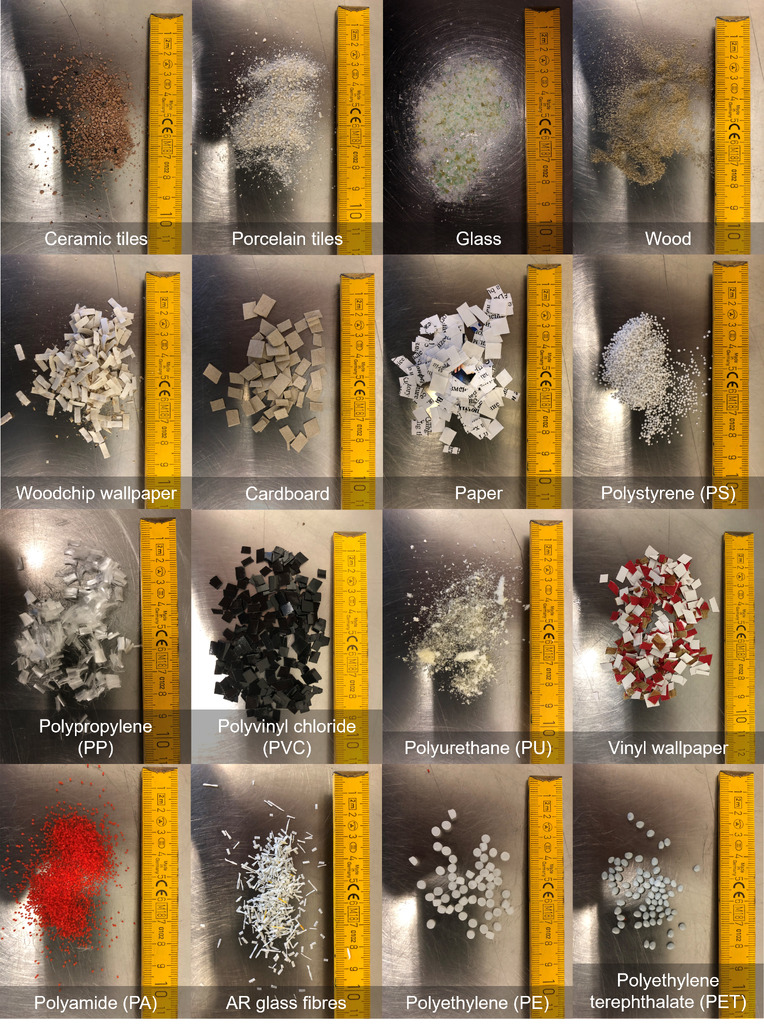
The investigated foreign materials are listed in Table 1 and illustrated in Figure 1.
Table 1: Representative contaminants in AAC waste investigated in this study, corresponding to Category X of DIN SPEC 91493:2026-05 [1].
No. | Contaminant | General Source of Contaminant | Material Used |
1 | Ceramic | Ceramic tiles | Crushed ceramic tiles (reddish-brown); Ø < 1 mm |
2 | Porcelain | Porcelain tiles | Crushed porcelain tiles (white); Ø < 1 mm |
3 | Glass | Glass bottles, window glass | Crushed glass bottles (colorless /green); Ø < 1 mm |
4 | Wood | Wooden pallets, window frames | Woodchips (saw dust); Ø < 1 mm |
5 | Woodchip wallpaper | Woodchip wallpaper | Wallpaper cuttings (white); 2 × 10 mm |
6 | Cardboard | Packaging and support material | Cardboard cuttings (gray); 5‑10 × 5‑10 mm |
7 | Paper | Paper-based wallpaper | Printer paper cuttings (white); 5‑10 × 5‑10 mm |
8 | Polystyrene (PS) | Insulation and packaging materials | PS beads (gray); Ø 0.5‑1 mm |
9 | Polypropylene (PP) | Packaging textile | PP fibers (colorless); length 5 mm |
10 | Polyvinyl chloride (PVC) | Window frames, films, floor coverings | PVC pond liner cuttings (black); 5 × 5 mm |
11 | Polyurethane (PU) | Construction foam | PU foam (yellow); 1‑2 × 1‑2 mm |
12 | PVC/ Paper Composite | Vinyl wallpaper / PVC textured wallpaper | Vinyl wallpaper cuttings (red); 5 × 5 mm |
13 | Non-woven (fleece) wallpaper | Non-woven (fleece) wallpaper | Non-woven wallpaper cuttings (black); 1 × 5 mm |
14 | Alkali-resistant (AR) glass fibers | Reinforcement mesh | AR glass fibers (colorless); length 5 mm |
15 | Polyamide (PA) | Plastic wall plugs (anchors) | PA granules (red); 0.5 × 0.5 mm |
16 | Polyethylene (LD-PE) | Construction film, protective sheeting | PE granules (colorless); Ø 3 mm |
17 | Polyethylene terephthalate (PET) | Beverage bottles | PET granules (gray); Ø 3 mm |
Production behavior and visual appearance after autoclaving
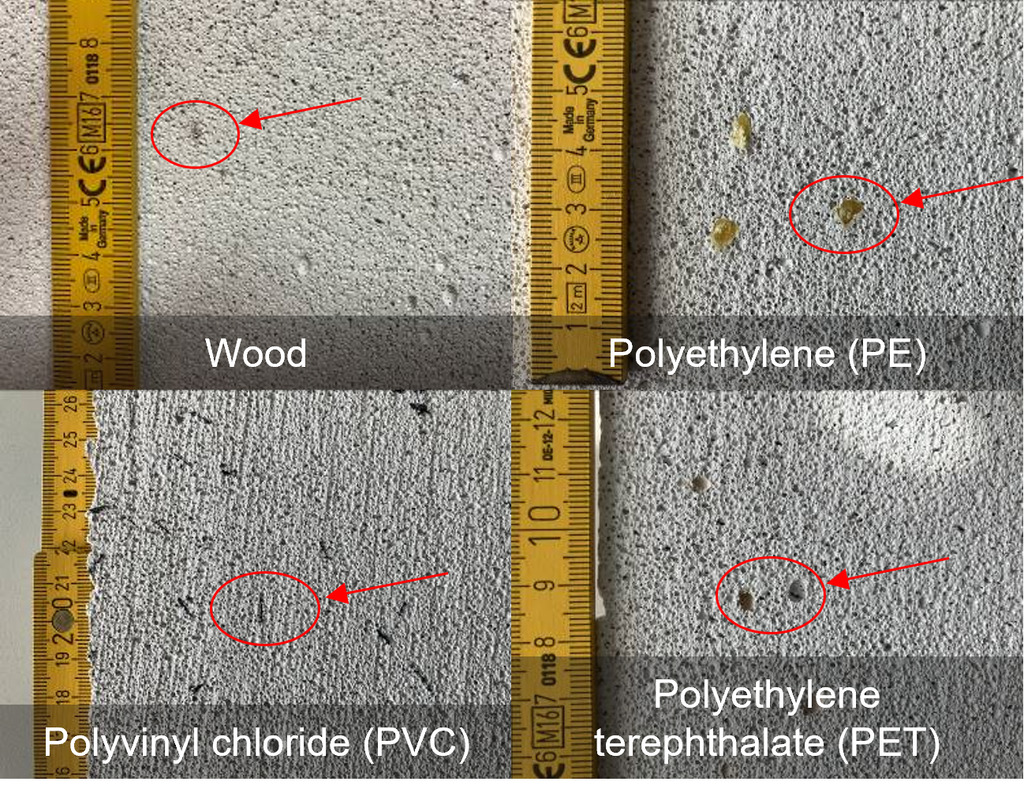
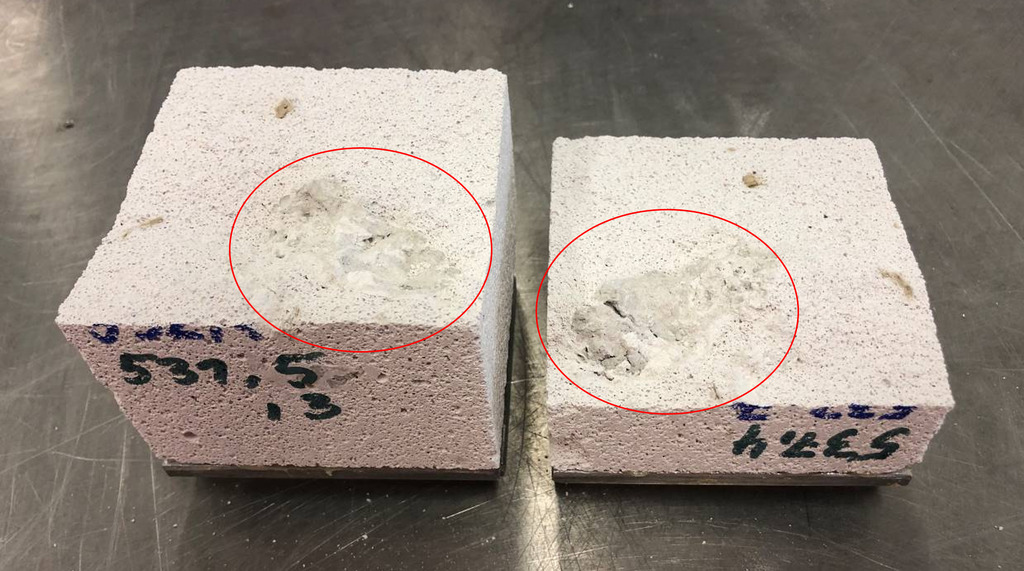
None of the contaminants affected casting behavior or early strength development. After autoclaving, residual particles remained visible in specimens containing wood, cardboard, woodchip wallpaper, PVC, vinyl wallpaper, and PE (a selection of the results is shown in Figure 2). The addition of PET resulted in voids roughly matching the size of the PET granules. Visual inspection revealed agglomeration of cardboard particles in one test specimen, suggesting reduced slurry homogeneity (Figure 3).
Dry density and compressive strength
All formulations complied with DIN 20000-404 [5] requirements. Dry densities were unaffected by contamination and remained within the lower end of density class 0.55 throughout [6]. Compressive strength was determined on 100 × 100 × 100 mm cube specimens according to EN 772‑1 after drying at (70 ± 5)°C to constant mass. Measured values were converted to the normalized compressive strength according to EN 772‑1:2011‑07, Annex A, using a conversion factor of 0.8 [7]. Differences in compressive strength between the reference and contaminant-containing formulations were evaluated using Welch's two-sample t-test. Woodchips caused a highly significant reduction in compressive strength (p < 0.01), while cardboard caused a significant reduction (p < 0.05). Although statistically significant, the reduction by woodchips and cardboard was limited to approximately 6%. For all formulations, the 50% fractile (p = 0,50) at a 95.0% confidence level remained well above the German specification limit of 4.6 N/mm², demonstrating compliance with a substantial safety margin (Table 2). Although PET addition led to the formation of localized voids, no statistically significant reduction in compressive strength was observed.
Table 2: Normalized compressive strength results: mean value, standard deviation, and 50% fractile at a 95% confidence level (50/95 value)
Contaminant | Normalized compressive strength | |
Mean ± SD [N/mm2] | 50/95 value [N/mm2] | |
Reference (no contaminant); n = 20 | 5.4 ± 0.2 | 5.3 |
Ceramic tiles; n = 10 | 5.4 ± 0.3 | 5.3 |
Porcelain tiles; n = 10 | 5.4 ± 0.3 | 5.3 |
Glass; n = 10 | 5.5 ± 0.2 | 5.3 |
Woodchips; n = 10 | 5.1 ± 0.2 | 5.0 |
Woodchip wallpaper; n = 10 | 5.3 ± 0.2 | 5.2 |
Cardboard; n = 10 | 5.1 ± 0.3 | 5.0 |
Paper; n = 10 | 5.3 ± 0.2 | 5.2 |
Polystyrene; n = 10 | 5.3 ± 0.3 | 5.2 |
Polypropylene; n = 10 | 5.4 ± 0.2 | 5.2 |
Polyvinyl chloride; n = 10 | 5.2 ± 0.4 | 5.0 |
Polyurethane; PU; n = 10 | 5.4 ± 0.3 | 5.2 |
Vinyl wallpaper; n = 10 | 5.2 ± 0.3 | 5.1 |
Non-woven (fleece) wallpaper; n = 10 | 5.3 ± 0.4 | 5.1 |
AR glass fibers; n = 10 | 5.4 ± 0.3 | 5.2 |
Polyamide; n = 10 | 5.4 ± 0.4 | 5.2 |
Polyethylene; n = 10 | 5.3 ± 0.3 | 5.1 |
Polyethylene terephthalate; n = 10 | 5.3 ± 0.4 | 5.1 |
Hygric performance
Total drying shrinkage εcs,tot according to EN 680 [8] averaged 0.28 ± 0.02 mm/m across all formulations, thus complying with the requirements of DIN 20000-404 and remaining well below the Xella internal upper limit value of 0.35 mm/m. Similarly, hygroscopic sorption [9] was unaffected, averaging 2.7 ± 0.2 wt.-%, which is substantially below the Xella internal upper limit of 4 wt.-%; no corresponding requirement is specified in DIN 20000-404.
Mineralogical analysis and chemical composition
Quantitative phase analysis by XRD-Rietveld showed no significant contamination-related changes in phase composition. The formation of tobermorite, which is largely responsible for the compressive strength of AAC, remained stable across all investigated formulations (42 ± 2 wt.-%). Residual quartz (20 ± 2 wt.-%) and amorphous mineral phases (18 ± 2 wt.-%) also showed consistent contents. No unexpected mineral phases were detected. Likewise, X-ray fluorescence (XRF) analysis demonstrated high consistency among all variants. Variations remained within normal AAC production ranges.
Conclusions
The results indicate that current industrial concerns regarding small amounts of common demolition contaminants may be overly conservative. Despite local visual effects, contamination had no practically relevant impact on AAC performance. The strength reductions observed for woodchips and cardboard are likely associated with local disturbances of the slurry homogeneity during mixing and pore formation. However, the effect remained limited, indicating that AAC production is relatively tolerant to small quantities of these materials. Cardboard was the only contaminant showing visible clumping behavior, likely due to its high water absorption. As this can impair process control, its removal should be considered a key requirement when preparing recycled AAC. The mineralogical results further demonstrate the robustness of the hydrothermal AAC production process towards small amounts of common demolition contaminants. The results therefore support the applicability of the Category X purity threshold specified in DIN SPEC 91493. It should be noted that the present study investigated individual foreign materials separately, and interactions between different foreign materials were not evaluated. Despite this limitation, the data indicate that further reduction of contamination levels is unlikely to be justified. While the investigation was limited to a single AAC strength/density class, the selected formulation represents a common commercial product and provides an industrially relevant basis for evaluating contamination tolerance. Confirmation of these findings for other AAC strength and density classes remains desirable.
References
[1] DIN e. V., DIN SPEC 91493, Preparation, utilization, and sorting accuracy requirements for recycled autoclaved aerated concrete; English translation of DIN SPEC 91493:2026-05; Available at: https://www.dinmedia.de/de/technische-regel/din-spec-91493/401512774 (Accessed: 24. August 2026).
[2] Walther, Hartmut, B., CO2 absorption during the use phase of autoclaved aerated concrete by recarbonation, AAC Worldwide, 1, 2022, 18-29
[3] Kreft, Oliver; Och, Nils; Müller, Holger; Weiß, Beate; Weber, Daniel; Höpke, Holger, DIN SPEC 91493 turns demolition-site AAC into a recyclable resource, AAC Worldwide, 3, 2026, 10-15
[4] Deutsches Institut fur Normung e.V. (German Institute for Standardization e. V.), DIN EN 771-4:2015-11, Specification for masonry units – Part 4: Autoclaved aerated concrete masonry units; German version EN 771-4:2011+A1:2015 , Beuth Verlag GmbH, Berlin
[5] Deutsches Institut für Normung e.V., DIN 20000-404:2018-04, Application of building products in structures – Part 404: Rules for the application of autoclaved aerated concrete masonry units according to DIN EN 771-4:2015-11, Beuth Verlag GmbH, Berlin
[6] Deutsches Institut für Normung e.V., DIN EN 772-13:2000-09, Methods of test for masonry units. Part 13: Determination of net and gross dry density of masonry units (except for natural stone); German version EN 772-13:2000, Beuth Verlag GmbH, Berlin
[7] Deutsches Institut für Normung e.V., DIN EN 772-1:2016-05, Methods of test for masonry units – Part 1: Determination of compressive strength; German version EN 772-1:2011, Beuth Verlag GmbH, Berlin
[8] Deutsches Institut für Normung e.V., DIN EN 680:2006-03, Determination of the drying shrinkage of autoclaved aerated concrete; German version EN 680:2005, Beuth Verlag GmbH, Berlin
[9] Deutsches Institut für Normung e.V., DIN EN ISO 12571:2022-04, Hygrothermal performance of building materials and products – Determination of hygroscopic sorption properties (ISO 12571:2021); German version EN ISO 12571:2021, Beuth Verlag GmbH, Berlin