Science & Innovation
Chemical composition and particle characteristics
The influence of sand differences on the properties of AAC
Loading...AAC, as a lightweight, porous building material with good thermal insulation and sound absorption properties, is widely used in the modern construction industry. It is primarily made from siliceous and calcareous materials through processes such as batching, mixing, pouring, raising, pre-curing, cutting, and autoclaving. Sand, as an important siliceous material, provides SiO₂ for AAC production. Under high-temperature hydrothermal conditions, it reacts with CaO to form calcium silicate hydrate, playing a key role in the strength and durability of the product [1].
Sands from different sources, such as quartz sand, M-Sand, tailings sand, and mountain sand, differ in chemical composition, mineral content, particle shape, and gradation. These differences significantly affect the performance of AAC products [2]. For example, the SiO₂ content in the sand directly affects the degree of reaction with CaO, thereby influencing the amount of hydration products formed and the product strength; the particle shape and gradation of the sand affect the slurry fluidity, raising stability, and the pore structure and strength of the product [3]. Therefore, in-depth research on the influence of different sands on the performance of AAC products is of great significance for optimizing raw material selection, improving product quality, reducing production costs, and promoting sustainable industry development.
Experimental investigations
Raw materials
The basic properties of the experimental raw materials are as follows:
· Cement: PO 42.5 grade ordinary Portland cement, initial setting time 160 min, final setting time 240 min, 3-day compressive strength 25.6 MPa;
· Lime: CaO content 82.3%, active CaO 75.1%, digestion time 10 min.
· Aluminum paste: Purity 98.5%, particle size 5-10 μm, gas production ≥170 ml/g.
· Water: Tap water, pH 7.2, total hardness ≤200 mg/l (as CaCO₃)
· Sand: Samples were taken from different AAC manufacturers. Their chemical composition and physical characteristics are shown in tables below.
Table 1: Chemical composition of sands
Sand type | SiO₂ | Al₂O₃ | Fe₂O₃ | CaO | MgO | LOI | Clay content |
Quartz sand | 96.8 | 1.5 | 0.4 | 0.3 | 0.2 | 0.8 | 0.5 |
M-sand (Granite) | 78.5 | 2.3 | 1.2 | 4.5 | 1.5 | 1.4 | 3.2 |
Tailings sand (Pb-Zn) | 72.5 | 13.8 | 2.6 | 4.2 | 1.7 | 3.0 | 0.8 |
Mountain sand (weathered sand) | 88.2 | 4.3 | 1.8 | 1.2 | 0.5 | 2.1 | 5.8 |
Table 2: Particle size distribution and physical properties
Sand type | Fineness modulus | Bulk density (g/cm³) | Specific surface area (m²/kg) | 0.08-0.6 mm Particle content (%) |
Quartz sand | 2.3 | 1.65 | 320 | 82 |
M-sand (Granite) | 2.5 | 1.58 | 350 | 75 |
Tailings sand (Pb-Zn) | 2.1 | 1.42 | 300 | 88 |
Mountain sand (weathered sand) | 2.4 | 1.55 | 280 | 85 |
Quartz sand has the highest SiO₂ content (96.8%) and the least impurities (Fe₂O₃, CaO), providing ample siliceous source for AAC. Manufactured sand has high angularity, large specific surface area (350 m²/kg), and strong bonding with cementitious materials.
Tailings sand has a significantly high Fe₂O₃ content (2.6%), which may affect the stability of hydration products; it has the lowest bulk density (1.42 g/cm³) and the lowest proportion of effective particle size in the 0.08–0.6 mm range (75%), requiring gradation optimization.
Mountain sand (weathered sand) has a high clay content (5.8%), the lowest angularity (45%), and a relatively low bulk density (1.58 g/cm³). The rock flour formed by the fragmentation of weathered layers reduces slurry fluidity and tends to adsorb moisture.
Experimental methods
The two-part test programme included the following test series.
· Test A: Fixed calcareous materials (Cement 15%, Lime 20%), water-to-solid ratio 0.58, sand content 60% (single sand variable);
· Test B: Fixed calcareous materials (Cement 15%, Lime 20%), mixed slurry fluidity, sand content 60% (single sand variable).
Production process: Raw material grinding (0.08 mm sieve residue: 15% ≤ fineness ≤ 25%) → Batching and mixing (dry mixing 2 min + wet mixing 5 min) → Pouring and raising (35-45°C) → Pre-curing and hardening (3-4 h) → Autoclave curing (1.25 MPa, 190°C, 8 h).
Table 3: Test A - mix proportions (mass %)
Raw material | Quartz sand group | M-sand group | Tailings sand group | Mountain sand group |
Sand | 60 | 60 | 60 | 60 |
Cement | 15 | 15 | 15 | 15 |
Lime | 20 | 20 | 20 | 20 |
Water-to-solid ratio | 0.58 | 0.58 | 0.58 | 0.58 |
Fluidity | 240 | 235 | 210 | 200 |
Aluminum paste | 0.08 | 0.08 | 0.085 | 0.085 |
Note: Due to inconsistent slurry fluidity, different aluminum paste dosages were used to ensure the same raising height.
Table 3: Test B - mix proportions (mass %)
Raw material | Quartz sand group | M-sand group | Tailings sand group | Mountain sand group |
Sand | 60 | 60 | 60 | 60 |
Cement | 15 | 15 | 15 | 15 |
Lime | 20 | 20 | 20 | 20 |
Water-to-solid ratio | 0.58 | 0.59 | 0.61 | 0.62 |
Fluidity | 240 | 240 | 240 | 235 |
Aluminum paste | 0.08 | 0.08 | 0.075 | 0.07 |
Note: Under the same fluidity, water demand differed. Aluminum paste dosage was adjusted accordingly to ensure the same raising height.
Influence of different sands on AAC workability
Relationship between slurry fluidity and water demand
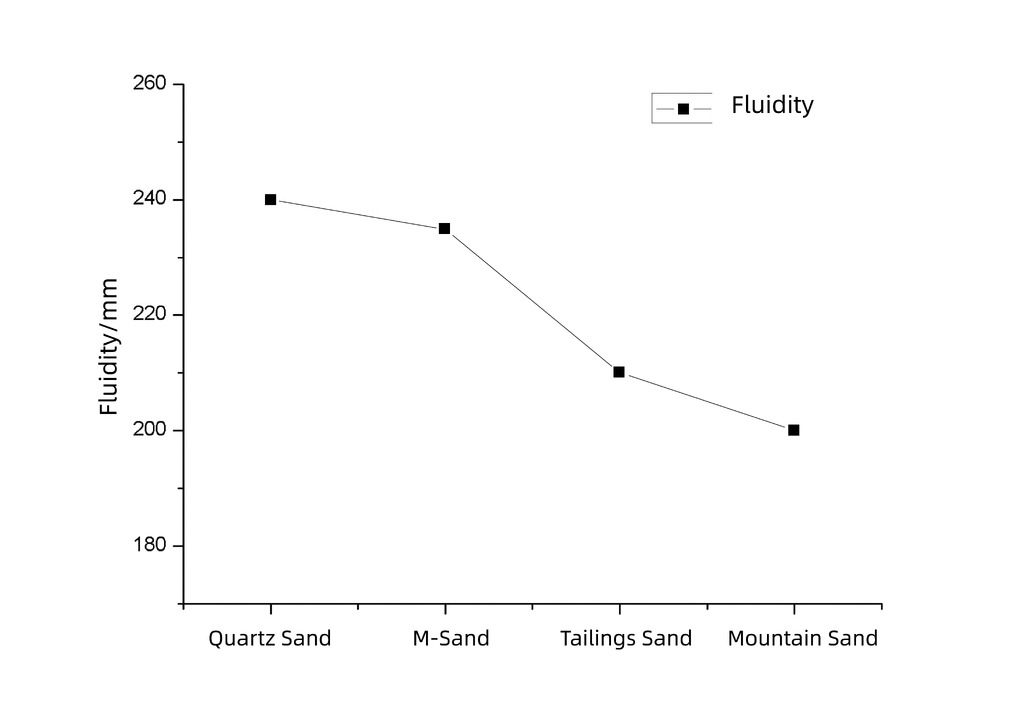
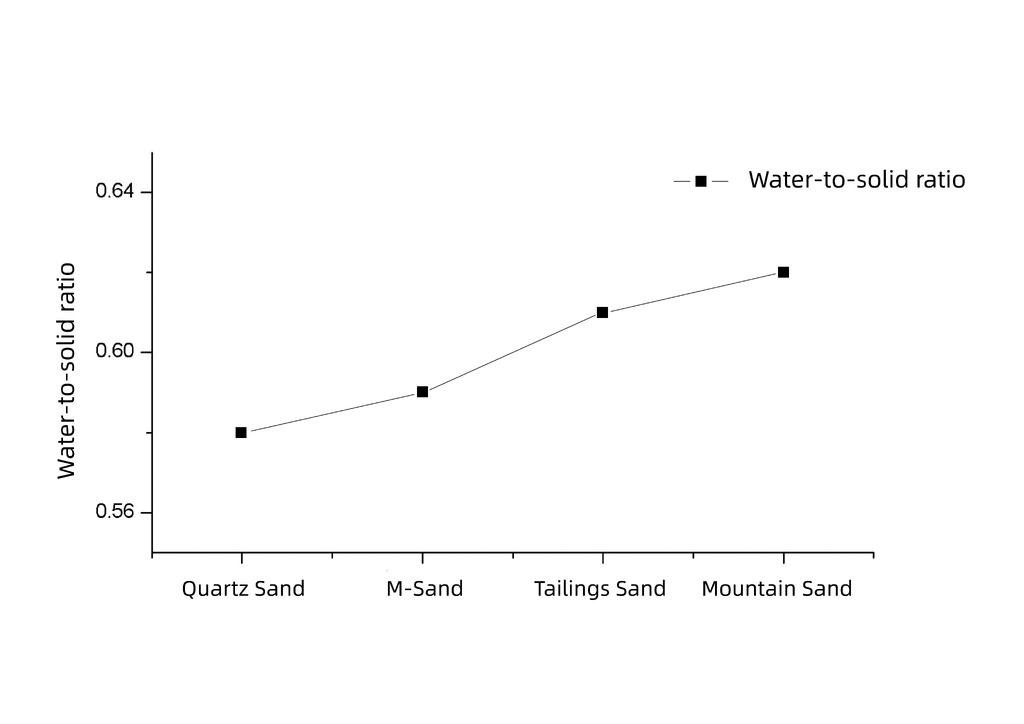
Slurry fluidity directly affects the uniformity of casting and raising. Under the same water-to-solid ratio, materials with higher water demand exhibit poorer fluidity. Test results are shown in Fig. 1 and Fig. 2.
Quartz sand AAC slurry had the highest fluidity (240 mm) due to its rounded particles and low voidage, resulting in low slurry resistance.
Mountain sand AAC slurry had the lowest fluidity (200 mm). High clay content and weathered layer detachment increased water demand; about 10% more water was needed to achieve the same fluidity.
Manufactured sand (235 mm) and tailings sand (210 mm) fluidities were intermediate.
Setting time
The setting time affects the formation of the green body and pore structure; both excessively long and short times are detrimental to production stability. Test results are shown in Fig. 3.
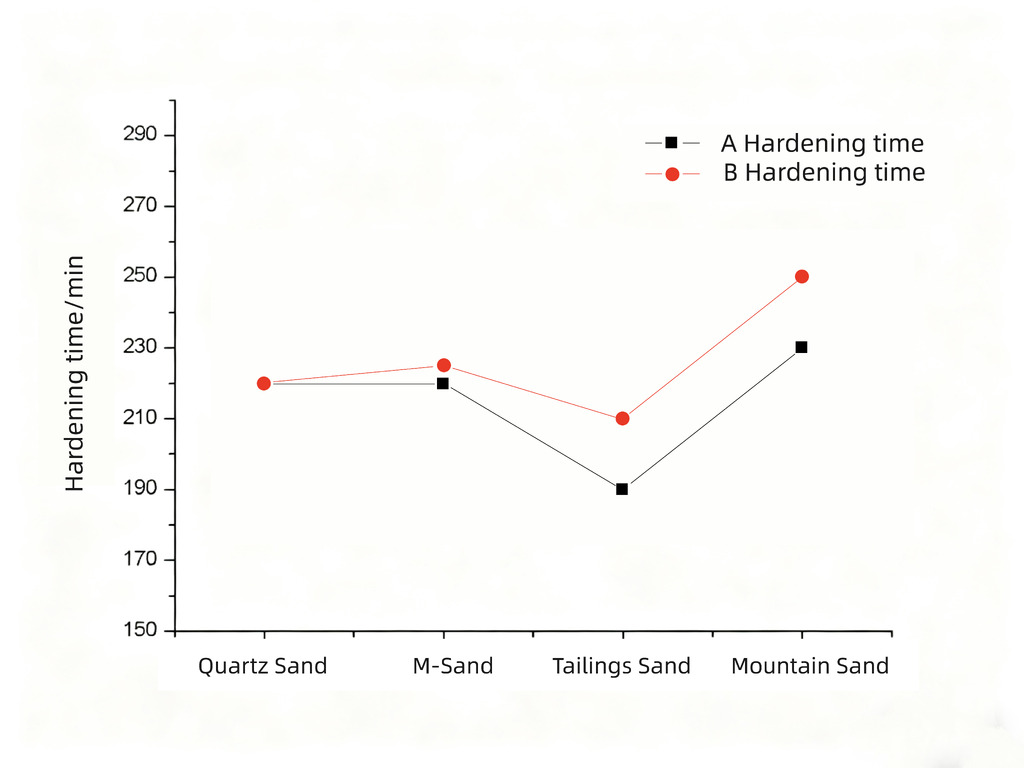
Tailings sand AAC had the shortest initial setting time (190 min), likely due to high active components accelerating cement-lime hydration. In return, mountain sand AAC had the longest setting time.
Performance test indicators and methods
The prepared AAC products were tested for various properties using the following specific indicators and methods:
1. Compressive Strength: According to GB/T 11969-2020 "Test Methods for Autoclaved Aerated Concrete" [4], using a universal testing machine, 100 mm × 100 mm × 100 mm cube specimens were loaded at a rate of (2.0±0.5) kN/s until failure. The failure load was recorded, and compressive strength was calculated.
2. Dry Density: Specimens were dried to constant weight in an oven at (60±5)°C, weighed, dimensions measured, and dry density calculated [4].
3. Porosity: Determined using the water displacement method. Dried specimens were weighed, saturated by immersion in water, surface moisture wiped off, and weighed again. The volume of absorbed water was calculated from the mass difference, and porosity was subsequently calculated [5].
4. Drying Shrinkage: According to the specifications of GB/T 11969-2020 [4], a comparator shall be used to measure the length change of the specimen at different drying times, and the drying shrinkage rate shall be calculated.
5. Frost Resistance: According to GB/T 11969-2020 [4], specimens were frozen in a low-temperature chamber at -15°C for 1.5 hours, then thawed in water at (20±5)°C for 1.5 hours, for 25 cycles. Specimen appearance was observed for spalling, cracking, etc. Mass loss and strength loss after freezing were measured.
Results and discussion
Characteristics of different sands
Different types of sand exhibit significant differences in chemical composition and particle characteristics. Quartz sand typically has an SiO₂ content between 70%-90%, with rounded particles, good gradation, and generally low clay content. The SiO₂ content of manufactured sand varies depending on the parent rock type, generally between 65%-90%; particles are often angular, and gradation can be adjusted through production processes, but it may have high stone powder content [6]. The chemical composition of tailings sand varies with the ore type; taking iron tailings sand as an example, its SiO₂ content can reach 60%-80%, and it also contains certain metal oxides like Fe₂O₃; particle shape is irregular, often with high fine particle content. Mountain sand has fluctuating SiO₂ content (50%-85%), more impurities, and complex particle shapes and gradation.
Influence of different sands on dry density and compressive strength of AAC products
Table 4 shows the compressive strength and dry density of AAC products prepared with different sands.
Table 4: Compressive strength and dry density of AAC products prepared with different sands
| Test A | Test B | ||
Sand type | Avg. strength | Avg. dry density | Avg. strength | Avg. dry density |
Quartz sand | 3.7 | 605 | 3.8 | 610 |
M-sand | 3.6 | 610 | 3.6 | 608 |
Tailings sand | 3.4 | 607 | 3.4 | 615 |
Mountain sand | 3.1 | 612 | 3.3 | 602 |
Quartz sand products exhibited the highest compressive strength. This is because the particle shape and gradation of quartz sand facilitate the formation of a stable skeletal structure in the slurry, and its high SiO₂ content meets the demand for full reaction with CaO to form calcium silicate hydrate, providing good strength support for the product [7]
Manufactured sand products showed relatively high compressive strength. The angular particles of manufactured sand interlock within the slurry, increasing friction and contributing to a dense structure [6]. However, if the stone powder content in manufactured sand is too high, it can absorb excessive water, affecting slurry fluidity and hardening speed, adversely affecting strength.
Tailings sand, besides SiO₂, contains metal oxides that may act as activators, promoting the hydration reaction of cement and lime, generating more hydration products, and enhancing the internal structure [8]. However, impurities in tailings sand might interfere with normal setting and hardening, and excessive fine particles may lead to a less dense internal structure.
AAC products prepared with mountain sand showed greater variability in compressive strength. Due to numerous impurities and unstable composition, some impurities might interfere with the hydration reaction of cement and lime, affecting the formation of hydration products and structure, leading to unstable strength. When mountain sand has lower impurity content and relatively high SiO₂ content, product strength can be acceptable. Overall, the use of mountain sand requires stricter screening and pretreatment.
Influence of different sands on drying shrinkage of AAC products
Test B specimens with the same dry density were selected to compare their drying shrinkage rates. As shown in Fig. 4, different sands significantly affect the drying shrinkage of the products.
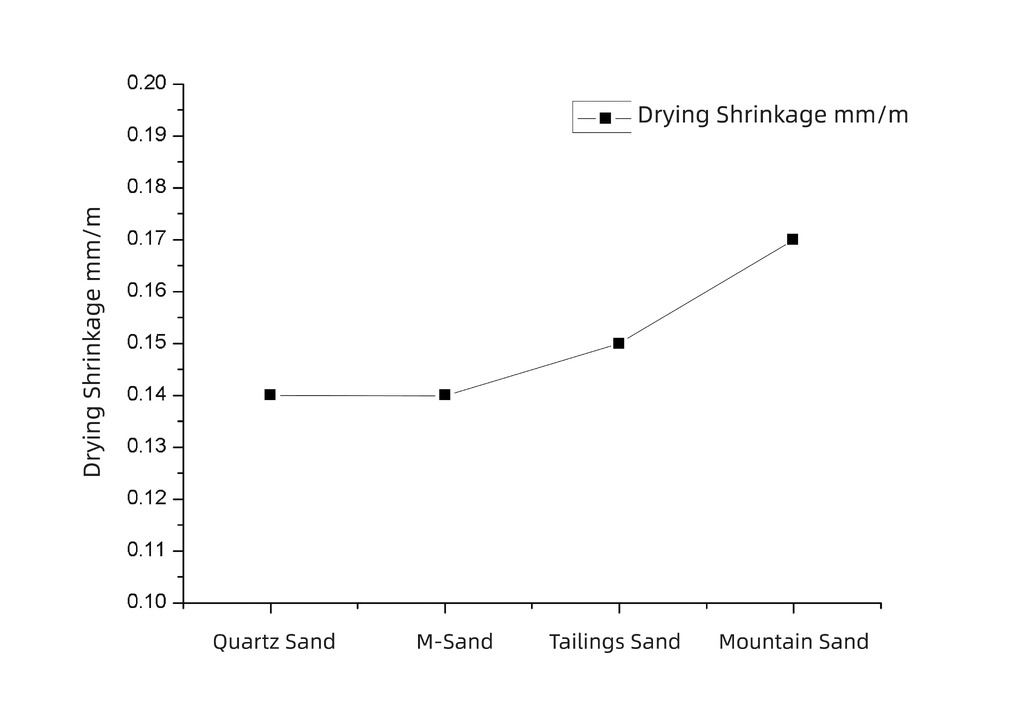
Quartz sand and manufactured sand products exhibited relatively small drying shrinkage rates. The chemical composition and particle characteristics of quartz sand contribute to a more stable internal structure, allowing for more uniform moisture loss during drying and reducing the likelihood of significant shrinkage stress [9].
The drying shrinkage of manufactured sand products is closely related to its production process and particle characteristics. If the particle shape is irregular and gradation is unreasonable, mutual constraints between particles and stress concentration during drying may lead to greater shrinkage. However, optimizing the production process of manufactured sand to achieve more reasonable particle shape and gradation can effectively reduce the drying shrinkage rate [6].
Some active components in tailings sand might undergo secondary reactions with cement and lime, consuming more water during drying and leading to increased shrinkage [10]. Simultaneously, the high fine particle content and large specific surface area of tailings sand make it more sensitive to moisture adsorption and release, also exacerbating drying shrinkage.
Mountain sand products showed significant variability in drying shrinkage rate. The type and content of impurities in mountain sand differently affect drying shrinkage. Some impurities like clay undergo volume changes during drying, leading to unstable shrinkage. When mountain sand contains more water-absorbent impurities, the drying shrinkage rate increases noticeably.
Influence of different sands on frost resistance of AAC products
Performance changes after 25 freeze-thaw cycles are shown in Table 5.
Table 5: Mass loss rate and strength loss rate of AAC products prepared with different sands after freeze-thaw cycles
Sand type | Mass loss rate (%) | Strength loss rate (%) | Appearance change |
Quartz sand | 2.1 | 10.5 | No cracks, intact surface |
M-sand | 2.8 | 13.2 | No obvious cracks |
Tailings sand | 3.5 | 16.8 | Local micro-cracks |
Mountain sand | 4.2 | 22.3 | Spalling at corners, crack length ≤5mm |
Regarding frost resistance, as seen from Table 5, quartz sand products exhibited the best frost resistance. After 25 freeze-thaw cycles, both mass loss and strength loss were relatively small. Mountain sand products had the poorest frost resistance.
Frost resistance depends on particle gradation and the compactness of the internal structure. When gradation is good and the internal structure is dense, frost resistance is better; conversely, it is poorer. The stable internal structure and moderate porosity of quartz sand products allow the structure to withstand certain stresses during freeze-thaw cycles when water in the pores freezes and expands, making it less prone to damage [11].
The angular particles of manufactured sand help enhance interparticle bonding force and improve the frost stability of the structure to some extent. However, if the particle surface roughness is too high or there are many microcracks, these may become initiation points for damage during freeze-thaw cycles [6].
The frost resistance of mountain sand products is greatly affected by impurities. When mountain sand has fewer impurities and reasonable particle gradation, frost resistance can be acceptable. However, if mountain sand contains more impurities prone to expansion or frost damage, such as clay or mica, volume changes of these impurities during freeze-thaw cycles can cause internal stress concentration in the product, leading to a significant decrease in frost resistance.
Conclusion
Different types of sand, such as quartz sand, tailings sand, manufactured sand, and mountain sand, exhibit significant differences in chemical composition and particle characteristics, which have varying degrees of influence on the performance of AAC products.
Manufactured sand can significantly improve the compressive strength and compactness of AAC products by optimizing production processes (e.g., adjusting crushing methods, controlling screening precision), but stone powder content must be strictly controlled (recommended 3-5%). Excessively high stone powder content can easily lead to decreased slurry fluidity, uneven pore distribution, and consequently reduce product strength and durability. Therefore, quality control of manufactured sand needs to run through the entire production process [6, 14].
Tailings sand can enhance the compressive strength of products within a certain dosage range, but as the dosage increases, drying shrinkage increases and frost resistance decreases. When utilizing tailings sand, the dosage must be strictly controlled, and corresponding measures should be taken to mitigate its adverse effects on product performance to achieve effective resource utilization of industrial waste [13].
Mountain sand requires multiple pretreatment steps (e.g., screening to remove impurities, washing to remove clay) before it can be used limitedly. Mountain sand has high impurity content, and its surface layer is prone to peeling; as an aggregate, its hardness is poor, affecting product strength, shrinkage, and freeze-thaw performance. It is more suitable for use blended with other siliceous materials [16].
Research prospects
Although this study clarified the influence patterns of different sands on the performance of AAC products, there are still directions for further exploration:
1. Further research could investigate the synergistic effects of composite sands (e.g., quartz sand-tailings sand blend, manufactured sand-mountain sand blend) on product performance. Optimizing the blending ratio could balance resource utilization maximization and performance enhancement.
2. Regarding the influence of impurities in tailings sand and mountain sand on product performance, comparative experiments involving impurity removal could be conducted. This would confirm the negative effects of specific impurities, enabling targeted testing and analysis.
References
[1] Zhongwei Wu, Huizhen Lian. High Performance Concrete [M]. Beijing: China Railway Publishing House, 2000: 89-95. (Elaborates on the action mechanism of siliceous materials in cement-based materials)
[2] Peiming Wang, Xianping Liu. Hydration Products and Microstructure of Autoclaved Aerated Concrete [J]. Journal of Building Materials, 2003, 6(2): 121-126. (Analyzes the influence of raw material characteristics on the microstructure and properties of products)
[3] Chongzhi Li, Naiqian Feng. Effect of Aggregate Particle Shape on Concrete Properties [J]. Concrete and Cement Products, 2005(4): 1-4. (Discusses the mechanism of particle morphology and gradation on concrete strength and fluidity)
[4] GB/T 11969-2020, Test Methods for Autoclaved Aerated Concrete [S]. (National standard specifying the standard procedures and parameters for product performance testing)
[5] Zhenyu Huang. Building Materials Science [M]. Beijing: Higher Education Press, 2019: 210-215. (Introduces the principle and operating procedures of the drainage method for porosity measurement)
[6] Zeyu Jiang, Chaoqi Lu, Wenhui Meng. Study on the Influence of Limestone Machine-made Sand Gradation on Concrete Performance[J]. China Sand & Stone, 2023(2): 38–43. (Analyzes the influence of particle characteristics and stone powder content of machine-made sand on concrete performance.)
[7] Shuhua Liu, Kunhe Fang. Effect of River Sand Quality on Concrete Workability and Strength[J]. Journal of Huazhong University of Science and Technology (Natural Science Edition), 2008, 36(8): 120-123. (Study on the influence of river sand gradation and silt content on concrete properties)
[8] Baosheng Zhang, Qiuyi Li. Application Research of Iron Tailings Sand in Autoclaved Aerated Concrete [J]. New Building Materials, 2010, 37(5): 1–4.(Discuss the influence of iron tailings sand content on the strength and microstructure of products.)
[9] Li Tian, Qiuyi Li. Study on Dry Shrinkage Characteristics of Lightweight Aggregate Concrete[J]. Journal of Building Structures, 2012, 33(Suppl. 1): 280–284. (Analysis on the mechanism of aggregate characteristics on concrete dry shrinkage)
[10] Shunzeng Zhao, Ling Wang. Influence and Mechanism of Iron Tailings Sand on Dry Shrinkage of Autoclaved Aerated Concrete[J]. Concrete, 2015(7): 65–68. (Study on the influence of fine particles and active components in tailings sand on the shrinkage performance of products)
[11] Faguang Leng, Pei Tian. Study on Test Method and Evaluation Index of Concrete Freeze-Thaw Resistance[J]. Journal of Building Materials, 2009, 12(3): 265–270. (Elaboration on the failure mechanism and evaluation method of freeze-thaw cycles in concrete structures)
[12] Wuxiang Wang. Application Technology of New Wall Materials[M]. Beijing: China Architecture & Building Press, 2016: 156–162.
(Summary on the application advantages and process parameters of river sand in the production of autoclaved aerated concrete)
[13] China Building Materials Academy. Technical Code for Application of Industrial Solid Wastes in Wall Materials: JGJ/T 429-2018[S].
(An industrial standard specifying requirements for the use of solid wastes such as tailings sand in wall materials.)
[14] Bing Chen, Guhua Li. Effect of Stone Powder Content in Machine-made Sand on Slurry Performance of Autoclaved Aerated Concrete[J]. Non-Metallic Mines, 2021, 44(4): 78–81. (Investigation on the influence of stone powder in machine-made sand on slurry fluidity and gas generation stability)
[15] Hongfa Yu, Wei Sun. Chloride Ion Corrosion and Protection Technology of Sea Sand Concrete [J]. Journal of the Chinese Ceramic Society, 2006, 34(11): 1385-1391. (Analysis on the corrosion mechanism of chloride ions in sea sand on cement-based materials)
[16] Yong Zhang, Jianzhong Liu. Effect of Mountain Sand Pretreatment Process on Properties of Autoclaved Aerated Concrete[J]. Building Materials World, 2019, 40(3): 1–4. (Study on the improvement effect of impurity removal and desilting processes of mountain sand on product performance)